Saturday, March 7, 2015

Non-Existence and Why We Shouldn't Be Afraid of it

The fear of death is most probably the biggest trigger out there for religion and faith.
Humans fear death, mostly because of the unknown element attached to it:
Without religion, we don't know what happens to us after death.
What do we feel? Where do we "go"? Do we keep our memories? Are we accountable for our deeds in life? So on and so forth.

The fear of death is also the most common "last stand" fallback position that theists go to when the foundations of their faith are rattled.

I can't even count the number of times theists brought this issue up when they seem to have run out of arguments and counter-arguments:
"So what happens after you die?", "You just stop existing and that's it?", "What's the point of living if it's all for nothing?", etc.

Well, there are several ways to approach this issue.
The most common answer that I've seen used by atheists is that after you die, you don't necessarily "disappear" into non-existence. You still exist in the memories of your loved ones and next of kin. And if you were truly a remarkable person, then you might even gain "immortality" by being remembered for untold generations to come.
Some "immortal" men for example: Albert Einstein, Isaac Newton, William Shakespeare, Ludwig Van Beethoven and so on, you get the idea. These people, although long dead, still "exist" in our everyday lives by the very fact of us remembering them and their achievements and lives.

Obviously, it's not a very 'satisfying' type of "immortality", because you're not there to enjoy it in person. So naturally, theists, selfish as they are, usually don't accept this kind of answer.

Another common answer atheists give is that the very fact that we are bound to die and stop existing at some point, only makes this life we have ever more precious and priceless.
It's an invitation to enjoy this one life we have and make the best you can out of it, because we have absolutely no other chance.

Theists usually don't seem to accept this answer either, although from my experience they don't really give a reason why. They just can't seem to wrap their heads around the notion of "one chance only". It's like automatically a reason for them to commit suicide and end the one life they have. It really boggles my mind why would anyone want to do that.

Personally, I agree with both of those common answers described above.
Yes, this life is precious because there's no other, and yes, we can achieve "immortality" by living in the memories of future generations (although it's an impersonal kind of "immortality"). Both of these notions together can push us to make the absolute best we can out of this life, as well as positively influence the world to make it better for future generations.

But there is another type of answer which is not so common. And here, although already more than halfway through this post, we reach the actual crux of the matter and the whole reason why I'm writing this.

We need to wrap our heads around an amazing fact. A mind-boggling, mind-blowing and yet a staggeringly simple fact:

We shouldn't be afraid of non-existence. Because we already passed it:
WE DID NOT ALWAYS EXIST.

What? You forgot? Where do you think you were before you were born, sugar?
You did not exist.

Do you remember this "non-existence"? You have memories of your experiences? Your feelings? Your ambitions? Obviously not. Because you did not exist.
And yet, the world existed all the same without you.

People lived. People died. People did this and that. Built things. Destroyed things. Killed each other. Saved each other. The rain was dropping. The sun was rising. The birds were singing. The dogs were humping. Life just... Went on.

So... Do you care about that, dear believer? Are you not upset about the fact that before you were born you did not exist? No? Why not? Isn't this fact just as disturbing as the fact that one day you'll be going back to that kind of state of non-existence?

Consider the following:
Let's assume, for the sake of argument, that before you were born you existed in some other form. Perhaps in some other dimension, perhaps as a completely different person. You had thoughts, memories, ambitions, and so on. But you don't remember any of that now, of course. All you remember is what you learned since after you were born into this life. Think for a second what that means. All those thoughts and memories of the person you were before... Everything that person went through... All of that was gone the moment you were born and started from scratch as a new person. How is that different from that other person... Stopping to exist? They stopped existing, and then you started existing as a whole other person with new memories and experiences.


This is, of course, a hypothetical scenario assuming there's such a thing as reincarnation or whatever.
But, as we already established, you don't really remember who or what you were before you were born, right? So... How is it different from the FACT that after you die, somewhere out there in the world, a new person is going to be born... A whole new person from scratch... Without any memories of what they were before they were born, but with new memories to gain in their new life? Who can say for sure that that new person will not be you? But since that "new" person won't have your memories anyway, does it really matter if it really is you or not?

How is it different?

So if you fear of nonexistence, get over yourself, champ.
You've already been there, done that.
Make the best of what you have.

Just remember one important thing:
After you're gone, the world will keep on living.
Humans will keep on being born.
So why not do what you can to make this world a better place for them?
For all you know, those "future" humans are...

You.


Tuesday, November 25, 2014

The Reverse Ontological Argument

Many of us have heard about the classical "Ontological Argument" conceived by Saint Anselm.

The argument goes like this:

If G-D is that, than which, no greater can be conceived and/or realized, Anselm argues, then nothing can be imagined that is greater than G-D.

If G-D does not exist, though, then something can be imagined, that is greater than G-D, namely a G-D that does exist.

The hypothesis that G-D does not exist thus seems to give rise to a logical absurdity: that there both is and is not something that can be imagined that is greater than G-D.

There is, because it’s possible to imagine a G-D that does exist. There isn‘t, because it’s impossible to imagine something greater than the greatest thing imaginable.

A hypothesis that gives rise to a logical absurdity, though, must be false.

The hypothesis that G-D does not exist, therefore, is false; thus G-D must exist.


There are many obvious problems with this argument, largely available on the internet.
Here's one of my favorites, for your viewing pleasure:


But you know, after giving it some thought, I came to this conclusion:
The Ontological Argument is actually completely ass-backwards!

The argument bases its nearly entire house of cards on the premise that perfect things are those that exist. But if you think about it, it's actually the complete opposite!

Perfection - by definition - DOES NOT EXIST.

What do I mean:
First, we need to define "perfection". What is "perfection"?
Perfection is that which we cannot imagine something better/greater than.
This is the same definition as used in the original argument.
Notice specifically that
the word "imagine" is the one being used.
The reason for this is that there's already a different word for the following definition:
"X is that which nothing better than it exists."
That word is: "Best".


However, even if something is "the Best there is", doesn't necessarily mean that it's "perfect". For example:
Let's say that I have the best computer processor in existence. It's the fastest, most efficient etc.. Is it "perfect"? Well, since speed and efficiency are relativistic terms, that means I can always imagine something better. So let's say the processor's speed is X, I can just imagine the same processor with a speed of X+10 for example, and presto: I have imagined a processor which is better than the best processor in existence. Therefore, the best computer processor in existence is NOT perfect (I can imagine something better). Does it mean that this "better" computer processor that I just imagined exist? Of course not, because I started with the premise of "the best computer processor in existence". It's an infinite induction.

As humans, our collective imagination is quite limitless. This means that whatever object we are presented with, we can always imagine something better if we put our minds to it. You can demonstrate it with every conceivable thing and if you think you found a thing which you can't imagine something better than, just present it to someone else until you find someone that thinks of something better.

YES, that includes the Abrahamic God as well. In fact, it's extremely easy to imagine something better, given that the Abrahamic God is arguably one of the worst gods in mythology.
For example: The Abrahamic God created Hell in order to punish the sinners. A better God would somehow turn all sinners into good people, thus not requiring anything as horrible as a Hell. Which is better? Lots of sinners and the existence of eternal torture? Or only good people in existence and no such thing as eternal torture? Obviously it's the latter. I have successfully imagined something which is better than the Abrahamic God, therefore the Abrahamic God is NOT perfect. The Abrahamic God is actually so bad that I can spend all day long thinking about flaws that could be fixed.

We can follow this reasoning to reach the inevitable conclusion:
Perfection, by definition, DOES NOT EXIST.
If you think you found something "perfect" - we can imagine something which is better, hence the "perfect" thing is no longer "perfect". It's now obsolete because there's this other more "perfect" thing which we imagined. And if that other perfect thing somehow comes into existence, we'd be able to imagine something even better. So on and so forth ad nauseum.

So, if in fact you define your God as that which is the most perfect being we can imagine, that would actually lead to the conclusion that God is the complete opposite of existence - which is non-existence.
Therefore, a perfect God, by definition - DOES NOT EXIST.


The Reverse Ontological Argument - Reductio Ad Absurdum Formulation

(1) A perfect being is that which no greater can be conceived.

(2) For every single being in existence, it is possible to imagine a greater being that does not exist.

(3) Let God be a perfect being that exists.

(4) From (2) it follows that we can imagine a greater being which is "more perfect" than God. We reach a contradiction with (3).

(5) Since we can imagine a being which is greater than Godit follows that either the being God is not perfect, or it doesn't exist.

Thursday, June 26, 2014

The Paradoxical Problem with the (self-refuting) Abrahamic God

This topic has been discussed millions of times before... on various forums, blogs, youtube channels and whatnot.
I don't have much to add to it, but I feel obligated to include it in my blog due to its importance.

The topic I talk about is of course how The Abrahamic God Refutes his own Existence by Definition.

Important note here:
This is NOT a refutation for every possible God there is.
Some kind of a God might exist, and it may also be that NO gods exist whatsoever.
I don't know and we'll probably never ever know. That's why I consider myself an "agnostic".
But what I can know for certain is that the Abrahamic god in particular (the monotheistic God of Judaism, Christianity and Islam), is by his own definition, either evil, nonexistent, or incorrectly defined.

The argument goes like this:


The Definition of the Abrahamic Monotheistic God


The Abrahamic God is defined by the scriptures of all three monotheistic religions as having the following main properties:

  1. All-Powerful (omnipotent)
  2. All-Knowing (omniscient)
  3. All-Loving (omnibenevolent)

The Existence of Evil and Suffering


Now we introduce into the argument the fact that Evil and Suffering exist.
This is a fact that we KNOW for certain. There is no going around that and we don't need to strive hard to find evidence for it.
People around the world are suffering... Badly... and A LOT.
One only needs to take a look at what's happening now in Egypt, Syria, Iraq and Israel (no matter which side you're on).
One could also make mention of horrible atrocities of the past such as the holocaust, the multitude of world wars and any kind of wars, slavery, genocide and good ol' fashioned plunder.
One could even mention all kinds of massive natural disasters such as tsunamis, floods, huge fires, tornadoes, hurricanes, famine and plague.
In every instance of these events we see innocent people suffering and dying for no good reason.
That is the fact of the existence of evil and suffering.

If you're a monotheist, you may also replace the words "Evil and Suffering" with the word "Satan". It will have the same effect in this argument.

So what does the existence of evil and suffering has to do with the Abrahamic God? Everything.

God vs Evil and Suffering


  1. If indeed God is All-Powerful, that means he has the power and means to end evil and suffering.
  2. If indeed God is All-Knowing, that means he knows how to end evil and suffering in the best way possible.
  3. If indeed God is All-Loving, that means he would want to end evil and suffering because he loves his creation and would want the best for them.
If all of the 3 properties of the Abrahamic God were true (and that he existed of course), then obviously evil and suffering would not exist.
But, obviously, as we established a moment ago, evil and suffering do in fact exist.

So, at least one of the three properties of the Abrahamic God must be false.
Either that, or, he simply doesn't exist.
In my opinion, accepting that the Abrahamic God simply doesn't exist makes it much easier to cope with the existence of evil and suffering (as I mentioned in my first blog posts).

But let's give him the benefit of the doubt for a moment, and assume that he exists.
So, as I said, at least one of the 3 properties must be false.
Let's see what that would mean:
  1. If God is NOT All-Powerful... That would mean that you can't trust him with everything because he would not have the power to deal with it. How can you trust him to answer your prayers? How can you trust him with your salvation in the afterlife? How can you trust that he's even the one who created the universe? Aren't theists the ones who keep claiming that creating the universe would require an all-powerful being? So what kind of a monotheistic God is that anyway, one who is not all-powerful?
  2. If God is NOT All-Knowing... How can you trust him to HEAR your prayers? How can you trust him to know what to do in every situation? How can you trust him with prophecies? How can you trust him that he'd know who is a true believer and who is not, who is a good soul and who is not? How can you trust him to give good judgement? And if God is not All-Knowing, does that mean you can trick him? outsmart him? That's not very Godly, is it?
  3. If God is NOT All-Loving... Well that would actually explain quite a lot. But the big question here is... would you really want to worship a God like that? Wouldn't it be almost like worshiping Satan? In fact, it would also imply that Satan might actually be the good guy in this story because he's the one who supposedly rebelled against this God, and offered humanity knowledge of good and evil (based on the genesis story). So on whose side would you prefer to be? Are you sure you're on the right side? The righteous, good, and just side? If you're morally superior to your God... What does that say about your God? And what does that say about you for worshiping such a God?

Free Will


Ah, "freewill", the trusty 'trump-card' that monotheists love to use so much.
Unfortunately, your belief in Heaven and Hell pretty much causes this argument to self-destruct.
For you see, punishing someone for using their free will IS NOT FREE WILL.
It could be called "theocracy", or even "dictatorship". But "freewill"? No.
It's not "freewill" by any contemporary definition of the word.

You see, in a normal system of reward-punishment, it's imperative that all adherents of the system are witnessing the reward-punishment actually being implemented.
If you can never witness a criminal being sent to jail, or visit a prisoner in jail, how can you possibly know jails even exist?
If you can never witness a criminal being executed, and not being able to see the dead body of an executed criminal, how can you possibly know that criminal was even executed at all?
Maybe this criminal was spirited away somewhere to a foreign country? Living under a false identity and sipping mai-tais in some luxurious beach?

So yeah, if you could actually witness heaven and hell, THEN it would be a reasonable reward-punishment system. THEN it would make sense, and THEN society could actually improve so much more.
But you can't, can you? Not unless it's already too late.
But that doesn't make for a very effective system, does it?

Here's another huge problem with the concept of Hell:
An infinite punishment for a finite crime.. is infinitely EVIL.
If you look at it mathematically, it'll be like dividing any kind of number by infinity.
Let's assume theft is represented by a number. Let's say... 5.
Let's assume that rape is represented by a higher number. Let's say 100.
And let's say genocide is represented by a really huge number such as 1,000,000,000.
And let's say that innocence is represented by 0.
Mathematically, it doesn't matter which of these numbers you divide by infinity, it's just the same as dividing zero by infinity, and they all asymtote equally.
They asymptote to ZERO.
Which is how much morality your God has for using infinite punishment for finite crimes.

The Joker Card - The Fourth Property


This is what I like to call "the Joker card" of monotheists. It's another property of the Abrahamic God. Number 4, if you will... And that is:

4. God is Unknowable.

Well, isn't that convenient? God is unknowable... hmm. Yes that could mean that God has some ulterior motive... Some "grand plan", if you will... Which for whatever reason requires the death and suffering of billions of innocents and there's absolutely no other possible way to make it work even though your God is omnipotent. Or it could also mean that we as mere mortals are incapable of understanding God... Of understanding the meaning of his properties.
Well I'm sorry but I find that hard to swallow.
If God is unknowable, isn't it possible his properties are unknowable too? And maybe one or more of the 3 properties we mentioned earlier are even wrong?
If God is unknowable, isn't it even possible that he's deceptive? What if you got fooled and you're actually worshiping an evil God? Maybe it's Satan in disguise?
If God is unknowable, how can you know the worth of his "plan"? Maybe it's a really bad plan? Or an evil one?

All in all, this is a very convenient argument which rids the monotheist from any further explanation.
"You just have to take it by faith", they would say.
Well I'm sorry, buddy. But that's simply not good enough for me.

Conclusion


Due to all of the above, we inadvertently reach one of the following conclusions:
  1. One or more of the 3 Abrahamic God's properties is wrongly defined.
  2. God is unknowable (and not very trustworthy).
  3. The Abrahamic God doesn't exist.
Any one of the 3 conclusions above makes the Abrahamic God not much worthy of worship or belief.

A couple of weeks ago I visited the Wailing Wall in Jerusalem as part of a trip from work.
Even though I don't believe in God, I prepared a note to put in the wall, and this is what I wrote in it:

Dear God,

I truly hope you exist...
And that you have a really damn good excuse for all of this.


Saturday, June 14, 2014

The Existential Crisis and The Importance of Physical Experience

The following video does an excellent job in explaining this position far better than what I possibly could.
So I recommend you watch the following and enjoy:
Atheism: Rationalism, Evidentialism, Verificationism

In summary, this video basically addresses the "Presuppositional Apologetics" which in essence claims something along the lines of "if everything you know to be true outside of your consciousness can be false, then how can you know anything?" (and then somehow magically claim that the Christian God in particular is the only way that you can make sense of the world, but we'll ignore that fallacy for now).

The Existential Crisis


Basically, it's true that outside my own consciousness, I can't really know for certain anything. The most basic assumption that I'm justified of making is "The fact that I'm contemplating my own existence - proves that I exist", or in Descartes's words: "I think, therefore I am".
This assumption does not encompass the nature of my existence. As far as I can tell, I could be a brain in a jar, or a human battery in a comma (like in The Matrix), being fed electrical signals to my brain which make me think that what I experience is real, while it's not. But whether I'm a brain in a jar, or a human battery in a comma, or a sophisticated AI living inside a simulation, I exist. It doesn't matter how and in what way, what matters is that I exist.

That is the minimum that anyone can know for absolute certainty.
But if you stop there, then what's next? What's the point of living if all of this could be fake?

But even if this is some kind of a virtual simulation, it's an awfully convincing one. There's no way for you to actually verify whether this world is fake or not, other than, perhaps, dying. But then, what if you're wrong? What if when you die, that's it? Are you truly willing to take that chance?

The answer is simply: accept it. Make the most out of this "simulation".
The world has worked consistently so far, so make the best you can within its known boundaries.
Any "external knowledge" that you acquire, has a chance of being part of the fake simulation, but since you have no way of knowing that, just accept it.


Unlike in The Matrix movie, you are not offered a blue pill and a red pill. It's not that simple.
The blue pill is your (possibly simulated) life.
The red pill is death.
And furthermore, unlike in The Matrix, you never actually meet someone who you know took the red pill and came back to tell you about it (like Morpheus or Trinity). So there's absolutely no reliable point of reference for you to discern whether it's justified or not.
Not only that, but sooner or later, you're going to take the red pill whether you like it or not.
Everyone dies at some point, including yourself.
So why hasten this fate? Enjoy the blue pill while you can. Make the most of it.

This thought process is nothing new or extraordinary.
It's an experience which most people go through, and most of them accept their fate.
This is called "The Existential Crisis". If you also had it, don't worry. It's normal, and it's common.

My opinion? Is that this psychological phenomenon is simply a side effect of us being a sentient and self-aware species. In fact, this is the very definition of being "sentient" and "self-aware".
So if and when you have existential doubts, just remember that you're having these thoughts because you're sentient and self aware. In fact, you can feel empowered that you have these thoughts. Be grateful that you're not a bacteria or something, and carry on with your sentient life.

The Importance of Physical Experience


So now that we established that we have to at least consider this world as real, whether we like it or not, how do we proceed? Or, more accurately - how do we establish truth?
The answer is in the title - Physical Experience.
Our human bodies were granted with at least five physical senses: Sight, Smell, Touch, Taste and Hearing.
These are the senses which allow us to sense the world around us, and come to conclusions based on it.

This is how we gain experience. We hear things. We see things. We smell, touch and taste things. By "recording" these experiences in our memory, we construct our understanding of the world.
Experience as a whole, is the total memory of what these senses received as input during our entire lifetime.

Some would argue that "intuition" is somehow also contributing to our experience and understanding.
But do you think, for example, that 1+1=2 is intuitive? Do you think it's somehow "self-evident"?
It's not.
Math is an abstract representation of reality... of things we can see and touch using our body.
You know that 1+1=2 because if you take one apple and put it next to another apple, it can be represented as 2.
Separate the two apples and each one of them can be represented as 1.
Put them together again and you have 1+1, which is represented by 2.

In other words:
"2" is an abstract representation of 1+1.
"+" is an abstract representation of the action of putting together two sets of objects.
And "1" is an abstract representation of a single physical object (an apple, a chair, a table...).

So 1+1=2 is NOT intuitive. It's something that you learn from experience.

So you see, even the simplest things which you THINK are intuitive, are actually not. EVERYTHING you know for certain is based on experience. Experience which you gain using your 5 senses.

In conclusion, it's important to base your knowledge and understanding of the world on your physical experience. It's also important to accurately define your understanding.
For example, let's assume someone tells you that atheists eat babies.
Based on that, what kind of truth claim can you make?
Can you truthfully claim that atheists, in fact, eat babies?
No. You can't. You have not seen atheists eat babies. All that happened is that someone told you that atheists eat babies.
That's it. That's the only honest truth claim that you can make in this regard: Someone told you that atheists eat babies.
Does it infer that atheists actually eat babies? No. Does it infer that the person who told you this has actually seen an atheist eating a baby? No.

So, if you want to be honest, all you could claim in this scenario is that "someone told you that atheists eat babies", and that's it.

This is why it's more accurate (and honest) to say things like "I've heard that scientists discovered supporting evidence for evolution", and it's a lot more honest than saying "evolution is fact".

This is why it's also more accurate (and honest) to say things like "The bible claims that God has created the world", and it's a lot more honest than saying "God has created the world".

So inspect your own understanding of the world.
Be skeptical.
And if you want to be honest, don't rush into truth claims without physical experience.

Monday, June 2, 2014

The Main Reasons I'm an Atheist: 3. EVERYTHING has a physical explanation

There are numerous reasons to why I'm an atheist.
In this final blog post in the series I'll be listing the last (and most crucial) one.

For the first post, please click here:

http://bigheadatheist.blogspot.co.il/2014/05/the-main-reasons-im-atheist-1-world-is.html

For the second post, please click here:

http://bigheadatheist.blogspot.co.il/2014/05/the-main-reasons-im-atheist-2-religions.html


3. EVERYTHING has a physical explanation (a.k.a. Why I'm a Materialist)

Even as a non-religious person, I often asked myself whether it's possible that supernatural phenomenons actually exist or not. The concept of the supernatural has a rather nice appeal to it.
It offers a new dimension to look at things. It suggests new and exciting worlds beyond the physical world we take for granted. The possibilities are literally endless.

For a long while, even until recently, there were many aspects of life that I could not find a physical explanation for them. Some things that as far as I knew just didn't seem to sit right with physics, astronomy, biology, chemistry and whatnot.


I'm going to list some common phenomenons that many people do not know how they become possible, or how they work, or how they could possibly comply with the physical world that we know (that also includes me until a few years ago):

  1. Smell
  2. Sound
  3. Sight
All of the things in the list above are something that you can only define subjectively. I mean, how can you explain sight to a blind person? How can you explain sound to a deaf person? How can you explain smell to a person who can't smell? Explaining them objectively is difficult (if not impossible). They are the result of our mind interpreting something subjectively. But are these things something that even exists outside our subjective experience?

Also, what about the next list?

  1. Electricity
  2. Magnetism
  3. Gravity
  4. Color & Light
Those are some seemingly mysterious phenomenons, aren't they? How can you explain them? I mean, just thinking about it makes your head hurt.

And finally, what do you think about the next list?:
  1. Memories
  2. Consciousness
  3. Soul
  4. Time
Wow.. Now that's some profound stuff there, isn't it? I mean, how can you explain these things? Do these things even exist? Or are they an illusion that we stamped a name upon? Big questions there indeed.

I pondered about these things quite a lot myself. And I wasn't ready to completely abandon the possibility of the supernatural until I could find a physical and provable explanation for these mysterious phenomenons.


Eventually though... I did.

One by one, I learned about the physical explanations for each and every one of the listed phenomenons.
Some of them caused me to facepalm myself and say "How could I be so stupid not to realize it myself??"
Others damn near blew my mind away and/or shocked the bejeezus out of me.
Piece by piece, the supernatural world shattered away, and revealed a physical world that was not only even more wondrous than my imagination, but it was amazingly real.

Now, it's good that we have something as useful as the internet. Information is amazingly accessible. I grew up in a generation that did not always have this kind of luxury.

But now that we do, why not put it to good use?
  1. The Sense of Smell (molecular receptors in our noses)
  2. How Sound Works (pushing air in various wavelengths of vibrations)
  3. How The Human Eye Works (light receptors in your eye)
  4. What is Electricity (electrons moving in one direction)
  5. What is Magnetism (the lining-up of electron movements in adjacent atoms)
  6. What is Gravity & Mass (large concetrations of matter attract each other - possibly related to magnetism but could be a separate force in itself)
  7. What is Light & Color (photons created in nuclear fusion - i.e. the sun - "filtered through" physical atoms which absorb some of the photons in certain wavelengths - as energy - and reflect the rest)
  8. What is Time (a subjective experience of the effects of space, matter, movement, and the speed of light & sound)
  9. How Human Memory Works (by combining the functions of many brain sections)
Soul and Consciousness are more complex questions. There are various theories but neuroscientists are still working on this. It's a work in progress.
All evidence so far, however, points that whatever soul and consciousness are, they're created in and managed by the brain. Evidently by multiple regions of the brain simultaneously.
The following link provides some interesting information: Human Consciousness.
And the following link leads to an interesting new find in neuroscience: 
Scientists accidentally discover human 'off switch'.

My personal theory is that consciousness is the culminating result of the aggregation of multiple cognitive abilities (such as the 5 senses, memory, pattern recognition etc.).
A nice analogy is the flocking emergent behavior in animals (as small as bacteria, and as big as fish and birds). On its own, each subject has a certain behavior. But when in a large group, its behavior changes to suit the collective behavior of the flock, thus a new behavior is emerged.
In other words: Consciousness is an emergent behavior from the 'flocking' of multiple cognitive abilities.

As for "souls"... Well, it was never really proven to exist anyway. There's absolutely no physical evidence to support it (and how could it? after all, it's non-physical by definition).
Recently I've heard about some 20-year-old hypothesis involving quantum science (called "Orchestrated Objective Reduction"). But it has been criticized heavily on every turn, so until it gains significant support and evidence, I wouldn't count too much on it.
On the other hand, check out the Split Brain Experiments if you want to see some evidence that refutes the whole spirit/soul/mind-body duality thing (warning: mindfuck alert!).

All in all, I guess the "soul" idea a nice notion that can comfort some people when dealing with death.
But my personal theory is that the concept of souls is nothing but wishful thinking and some imagination.
People die. Deal with it. In the very least, let this notion encourage you to make the most out of the life you know you have, and make it as best as possible for yourself and other people.

So, in conclusion:
As experience taught me, many things that were considered mystical and/or supernatural, eventually always were discovered to have a physical and natural explanation.
As for the phenomenons for which no concrete physical evidence was found yet...
Let's just say I have faith trust in science that eventually such evidence will be found :)


Saturday, May 31, 2014

The Main Reasons I'm an Atheist: 2. Religions are Unreliable

There are numerous reasons to why I'm an atheist.
In the next blog posts I'll be listing the main ones.

For the first post, please click here:
http://bigheadatheist.blogspot.co.il/2014/05/the-main-reasons-im-atheist-1-world-is.html


2. Religions are Unreliable

An important question every religious person must ask themselves is this:
"How can I know that my religion is the correct one?"

Given the literally thousands of different religions out there, which also very often contradict each other, this is indeed a very difficult question.
Each of these religions has 'holy scriptures' just like yours.
The followers of each religion have 'divine experiences' just like yours.
Each has an internally consistent doctrine just like yours.
And yet... Followers of one religion are considered heretics of another.
The followers destined for the heaven of one religion, are destined for the hell of another.
This situation is completely ridiculous!

If religions were indeed divinely inspired by a single god or a single group of gods, then obviously there would be consistency between them. Not only that, but you'd expect the same religion to show up independently in different parts of the world.
Did this ever happen? No. Not ever. Not even once.

But if religions are indeed man-made, then you'd expect each religion to suit the character of the culture within which it was created. You would expect religions to be different from one another and often contradictory. You would expect new religions to pop up all over the place all the time.
Does this ever happen? YES. ALL THE TIME. EVEN TODAY.

The Jewish religion is characterized by the Mesopotamian culture from whence it came.
The Christian religion is characterized by both the Jewish-Mesopotamian culture from which it evolved, as well as the Greek Mithraistic culture where it was developed.
The Muslim religion is characterized by the desert-dwelling Arabian Peninsula culture.

Every Pagan religion is also characterized by the culture and environment where it was created.

Lets look at more recent examples:
Scientology? Characterized by science-fiction tales, as fitting for the science fiction author who created it.
Mormonism? Characterized by the North-American culture in which Josef Smith grew up.
Both of which, by the way, are documented con-men.

In India, there's a new self-proclaimed Hindu messiah just about every month.

Despite all this ridiculous amount of contradicting evidence, a huge number of people still fall for it.
Is it so hard to believe that ancient people were just as gullible as they are today?
In fact, given the documented ridiculous beliefs people used to hold, wouldn't it make sense that ancient people were even more gullible and dumber than we are today?

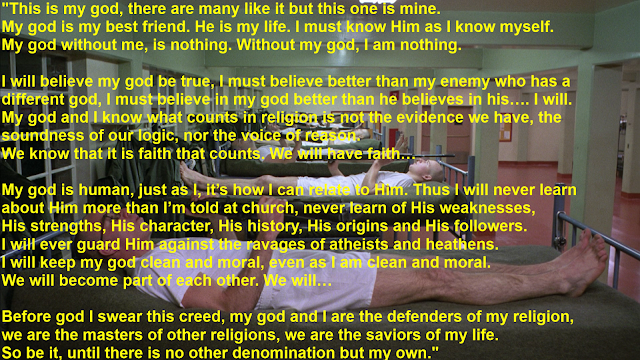
http://bigheadatheist.blogspot.com/2015/09/this-is-my-god-there-are-many-like-it.html


So...
How CAN you know that your religion is the correct one?
Obviously, you can't. Most religions rely on unfalsifiable and infallible claims which you cannot verify or disprove.
The few claims which are falsifiable... Have already been falsified - repeatedly.
The more logical conclusion is therefore - ALL religions are false.
Including yours.

The following YouTube series demonstrates just how psychologically fallible the human mind is.
It shows what kind of psychological vulnerabilities are being exploited by just about every single religion out there.

I highly recommend you watch all of it:
Psychology of Belief


The Main Reasons I'm an Atheist: 1. The World is Full of Evil and Suffering

There are numerous reasons I'm an atheist.
In the next blog posts I'll be listing the main ones.

1. The World is Full of Evil and Suffering

Before:
Maybe I'm just a too sympathetic guy, but I can't bring myself to reconcile with the fact there's so much suffering around the world, and at the same time there's some all-powerful dude out there who is doing nothing to fix it.
It started with me being rather selfish as a child (I see it now), and being rather dumbfounded that I'm doing my best to be a "good boy", and yet the "bad guys" are the ones who get popular, get all the girls, and all in all seem successful... while I'm being picked on by thugs for no reason, and can't get any girl to like me.
In a world where good people are supposed to be rewarded and bad people are supposed to be punished, this state of affairs did not make sense to me.

In time, as I grew up, I was exposed to more and more suffering around the world. There are no words to express just how much evil exists in the world... And the most ironic part? The worst possible atrocities are committed in the name of... you guessed it: Religion.

After:
Once I came to accept the fact that there's no God, and there's no divine reward/punishment system in place, I came to the following conclusion:
Humans are aggressive and selfish animals. They are social animals, but at the same time, the concept of the strong survives is still biologically important. It's natural selection. It's simple math:
Take two groups of people: One is aggressive, the other is docile.
Put them in the same location. What would happen?
Since the first group is aggressive, it'll behave aggressively towards the second group.
Since the second group is docile, it will not respond aggressively to the first group.
The first group will eventually exterminate the second group.
Thus the aggressive group flourishes, while the docile group perishes; the 'aggressive genes' move on, while the 'docile genes' go extinct.

Here's another scenario:
Take two groups of people which are identical in terms of aggressiveness.
Put each of them in a different ecosystem: One is in a lush and fertile environment. The other in a harsh desert environment.
The first group can breed and sustain itself rather easily because resources and food are plentiful and easy to access.
The second group has a limited amount of available resources and food. If the group keeps breeding, soon enough they'll exhaust the resources of the environment. They'll have two options:
Either emigrate to a different ecosystem.
Or fight over the resources among themselves.
Those that stay and fight will in time develop instinctive aggressive traits, because that's how they'll survive. They'll be more protective of their bloodline because trust will be difficult to come by (it's easier to trust your own family to not kill you over a well of water for example).
And thus, in time, the first group becomes more docile, while the second group becomes aggressive and over-protective.

There are other examples of scenarios that can explain why would humans become aggressive and selfish. But I don't think there's a point of listing all of them here. If you just put your head to it and/or do some research, it's rather easy to think about such scenarios.

So in conclusion, there are biological, environmental, and genetic explanations to why there's evil and suffering in the world.

Put a divine entity into the mix and suddenly it won't make sense:
An all-powerful being could equalize the environments and give a fair chance to all groups. In a perfect world, there's no need to fight over resources. If you were an all-powerful being, you could think of countless ways to make things better.

But take the divine entity out of the equation, and everything falls into place: The world has evil and suffering because that's how humans survive in a limited-resources environment - on the expense of others. It makes so much more sense, and most importantly - these scenarios are SCIENTIFICALLY DEMONSTRABLE. There were numerous scientific experiments which were done on mice and apes, where exactly this outcome has happened.
Watch the world news at any point in time, and you'll see the same outcome in humans.